Aug 2026
Only 18¢ of Your AI Dollar Reaches the Product. Here's How to Fix It.
Rework has always been most of the work. What changed is that generation outran review, and the two things everyone is buying more of are making it worse.
The “why” is curiosity — never challenge. It's how I get to root cause.
Founder, Exponential OS — a multi-agent harness with a constitution, agentic memory, model routing and composable skills. 25+ years in engineering. 6 years at Google across a ~$40B portfolio, $500M+ ROI. Most recently Engineer in Residence at AI Fund, Andrew Ng's venture studio.
As an Engineering Leader, I have found that the most complex technical challenges—from managing $40B portfolios at Google to compressing supply chain recall from months to seconds—are solved by identifying the core “Why.”
To be clear: this is a strictly curious “Why”. It is never about challenging authority or arrogance. It is a relentless drive to drill down to the fundamental root cause and fix the broken system.
The method is to build the harness before the product: governance that enforces engineering invariants as gates, memory that carries context across sessions, and evals fixed before any code is written. A change ships only if it beats baseline. That is how I ship outcomes rather than features.
Question the baseline before you scale.
Design for reliability at every failure mode.
Outcome-driven engineering, not just feature delivery.
Architecting reliability-first AI systems and evaluation-driven agent platforms. ex-Google engineering leader.
View Case StudiesFounder, ExponentialOS. Patent filed (exponential OS architecture). 10x Hackathon Champion. Compressing 6-month cycles to 6 seconds.
View Case StudiesBerkeley Haas EMBA 2026. UC Berkeley Faculty — 1,500+ Fortune 500 executives taught AI systems. Leading 50+ engineers at scale. $40B Google portfolio.
View Case StudiesRework has always been most of the work. What changed is that generation outran review, and the two things everyone is buying more of are making it worse.
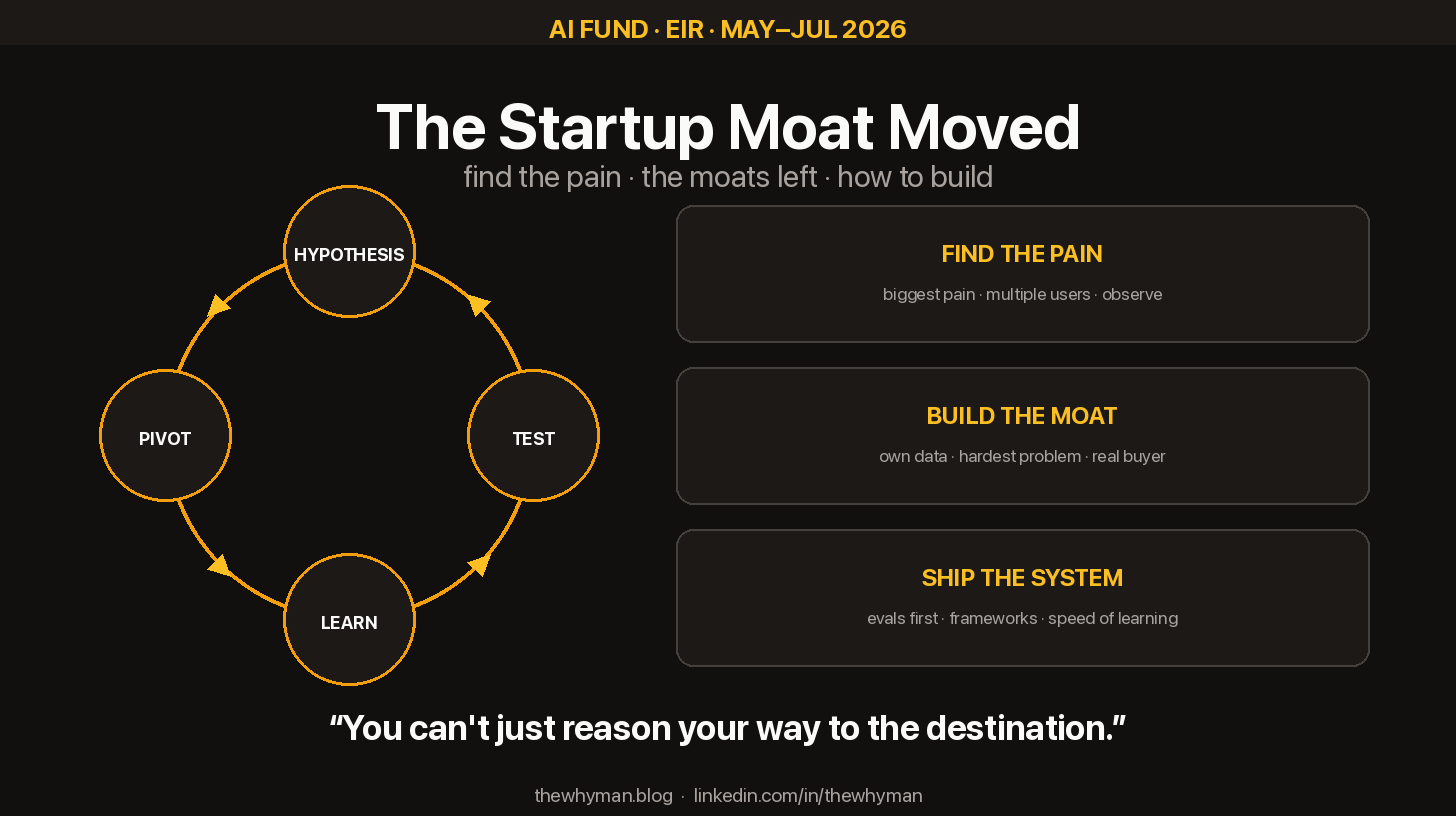
Three months as an EIR at Andrew Ng's AI Fund — on finding the pain, the moats that are left, and how you actually build now.
Ranking on Google and being citable by AI are not the same problem — and I asked four engines the same question to prove it.
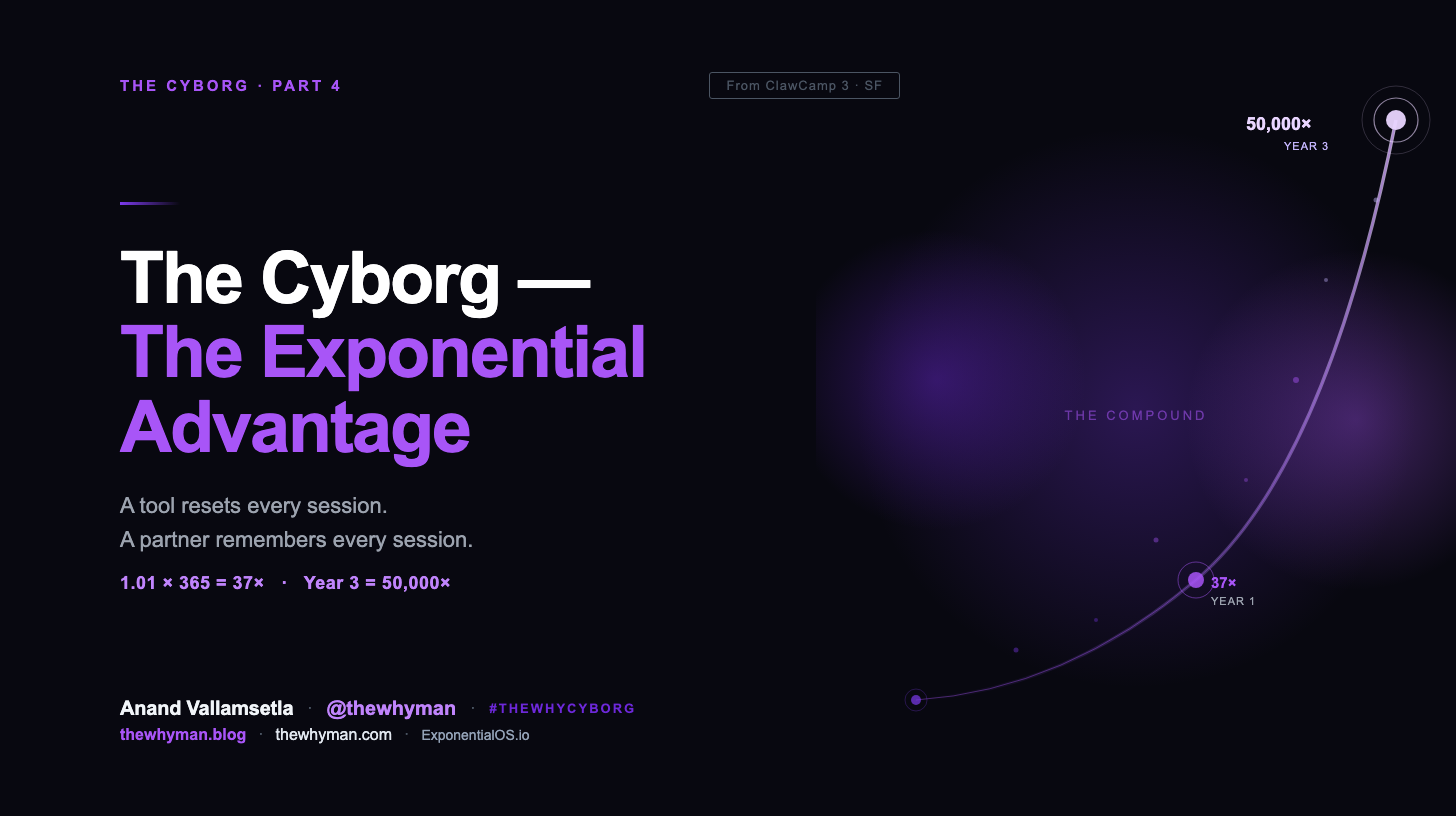
What the ClawCamp talk was really about, and the patent-night story I didn't tell on stage.
The five that come up before anything else — including the two people usually wait until the call to ask.
Most candidates have USED an agent framework. Anand built his own multi-agent harness — governance, memory, routing and skills as first-class layers — and shipped real product on it. The memory and context-management layer in particular is something very few practitioners have built; it is the difference between using agents and architecting the system agents run inside.
Both, deliberately. He sets technical direction and writes the code, and he has 17 years of engineering management behind it — a $40B+ portfolio at Google with 5 direct reports each leading their own pods, and 50 reports at Trellis. He is targeting senior IC-architect and engineering-leadership roles equally.
$500M+ ROI across 6 GCP engineering tracks within a ~$40B Google portfolio; 5 direct reports each leading pods; vendor P&L across Dassault, EPAM and AODocs; 50 engineers at Trellis; 99.99% availability in regulated financial systems at Charles Schwab; and 1,500+ Fortune 500 executives taught at UC Berkeley.
He is not running from anything. He has already run the independent path, and that is exactly why he knows what he wants. He built his own harness because he wanted leverage on hard problems, not an escape from them. What working alone does not give him is a problem at real scale with real distribution behind it. That is what he is looking for: a hard applied-AI problem, the scope to architect the system around it, and a team that ships. The instinct to build infrastructure before product is a long-horizon one; it is why the harness exists at all.
A fair question, and he does not deflect it. He knows precisely what solo work gives and what it does not: full autonomy, but no scale and no distribution. Those two are what he wants back, and they are what a strong team provides and independent work cannot. The consistent pattern across 26 years is that he builds the system that makes the whole team faster, at Google across a $40B portfolio and again in his own harness. That is a long-horizon instinct rather than a short-tenure one. What holds him is a hard problem with real reach behind it and the scope to architect the system around it.
Architectural Integrity • Global Operations • AI Governance